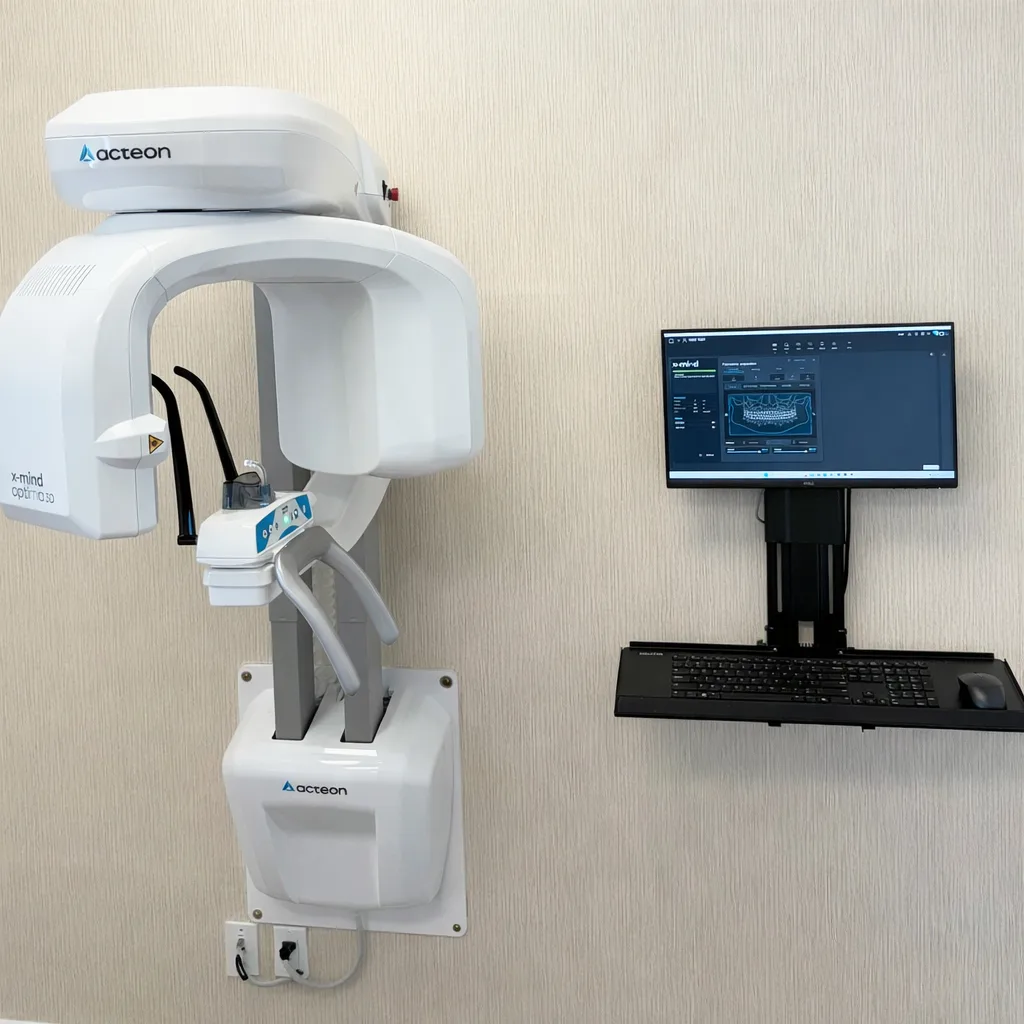
Technology at Pearl White Dentistry
3D Cone-Beam Computed Tomography (CBCT)
A clearer view when your care calls for more detail. Our in-office CBCT system can show teeth, bone, and nearby anatomy in three dimensions to help us plan selected treatments with greater context.

A more complete picture
See beyond a flat image.
A traditional dental X-ray gives us a two-dimensional view. Cone-beam computed tomography, or CBCT, combines X-ray images into a three-dimensional view that can be explored from different angles.
That added perspective can help Dr. Daashoush understand the position of teeth, the shape and amount of jawbone, and the relationship between dental structures. It is one part of a careful evaluation, alongside your history, examination, and treatment goals.
We use imaging purposefully. A CBCT scan is not a routine part of every appointment; we recommend it when the extra detail is likely to help answer a specific clinical question.
Why we may recommend it
Detail that supports a considered plan.
Planning for implants
A 3D view can help us assess available bone and the location of nearby anatomy before discussing an implant plan.
Explore dental implants ↗Understanding tooth position
When a tooth is impacted or an extraction needs closer evaluation, imaging may reveal details that are difficult to judge on a flat image.
Explore extractions ↗Investigating a concern
Some symptoms or findings call for a closer look at a tooth, surrounding bone, or jaw. We explain what question the scan is meant to answer before recommending it.
Explore dental X-rays ↗What to expect
A straightforward scan, explained clearly.
We will tell you why a 3D image may be useful for your care and discuss any questions before imaging. During the scan, you position your head in the machine and remain still while the arm moves around it. There is no instrument placed inside your mouth for the CBCT scan.
Afterward, Dr. Daashoush reviews the images alongside your exam findings and explains how they affect the options available to you. If a standard dental X-ray provides enough information, we may not need a CBCT scan.
CBCT FAQs
Questions worth asking.
We are happy to walk through why an image is recommended and what we hope to learn from it.
How is CBCT different from a regular dental X-ray?+
A regular dental X-ray shows a two-dimensional view. CBCT produces a three-dimensional image that can reveal the position of teeth, bone, and nearby structures from more angles.
Will I need a CBCT scan at every visit?+
No. We recommend 3D imaging only when it is appropriate for a particular concern or treatment plan. Many visits can be evaluated with an exam and standard dental X-rays.
Does a CBCT scan use radiation?+
Yes. CBCT uses X-rays. We consider the benefit of the information against radiation exposure and select imaging based on your individual clinical needs.
What happens after the scan?+
Dr. Daashoush reviews the images with your examination findings, then explains what they show and whether they change the recommended next step.

Thoughtful technology
See how the details fit your care.
Talk with our team about your concern and the information needed to plan your next step.